T4
Year-end employment slip that reports remuneration paid and key payroll deductions from the calendar year.
T4
A T4 is the Canadian year-end slip that reports employment income and related payroll information for the year.
It plays a role similar to the U.S. W-2, but the Canadian term and reporting framework are the standard here. The T4 connects the payroll records built one pay period at a time to the employee’s year-end reporting document.
Why T4 Matters
The T4 matters because it summarizes payroll information employees need after year end and employers need to prepare accurately from their payroll records.
It brings together:
- employment income
- source deductions recorded during the year
- year-end payroll reporting
If payroll records are wrong during the year, the T4 is one of the places those issues may surface.
How It Works In Canada
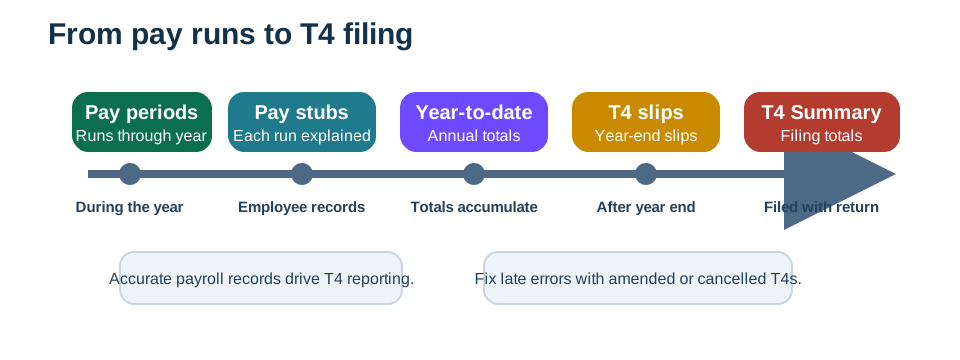
Payroll does not create the T4 one paycheque at a time as a separate document. Instead, the T4 is prepared after year end from the payroll records and year-to-date figures accumulated during the year.
That is why it should be understood as:
- different from the pay stub, which explains one payroll period
- different from the ROE, which serves another payroll-record purpose
- connected to payroll records such as source deductions and earnings totals
| Record | Main job | Typical timing |
|---|---|---|
| Pay stub | Explains one payroll period’s earnings and deductions | During the year, each pay run |
| T4 | Reports the year’s employment income and payroll deductions for the employee | After calendar year end |
| T4 Summary | Totals the T4 slips for one payroll account on the employer side | Filed with the T4 return |
| RL-1 | Reports Quebec year-end employment information where Quebec reporting applies | After calendar year end in Quebec context |
This flow shows how regular payroll records build toward year-end T4 reporting:
Example
An employee receives pay stubs throughout the year. After year end, the employer uses payroll records and accumulated year-to-date figures to prepare the T4 for that employee. If the employee worked in more than one province or territory during the year, payroll may need separate T4 slip reporting by province or territory.
Common Misunderstandings
- T4 is not a pay stub. It summarizes the year.
- T4 is not an ROE. The ROE is a different payroll record for a different purpose.
- T4 reports income for the year it was paid, not necessarily the year it was earned. Year-end reporting follows payment timing rules.
- T4 is not the employer summary. The T4 summary supports the employer side of filing.
Related Terms
Knowledge Check
- Is a T4 a Canadian year-end payroll slip? Yes.
- Does a T4 replace the need for pay stubs during the year? No.
- Is a T4 closer in purpose to a W-2 or to a pay stub? It is closer in purpose to a W-2.
Caveat
Exact boxes and year-end details depend on current reporting rules and the worker’s situation. The enduring concept is that the T4 is the main Canadian employment-income slip built from payroll-year records, not from a single pay run in isolation.